Service Expertise Certification Program
The brief came from the strategy layer — a vision for a new employee certification program with potential to change how the business thought about service expertise. What wasn't clear was how much of it was validated assumption versus untested idea. Rather than treat that ambiguity as a problem, the team leaned into it. We ran the whole thing like one big experiment — build in the checkpoints, stay honest about scope, and find out what's actually true.
We started big — a cross-functional ideation workshop with 30–40 people across product, technology, business stakeholders, and store operations. The goal wasn't to generate solutions. It was to surface what the organization actually needed: the ideas, the dependencies, the gaps across channels and touchpoints that no single team could see on their own.
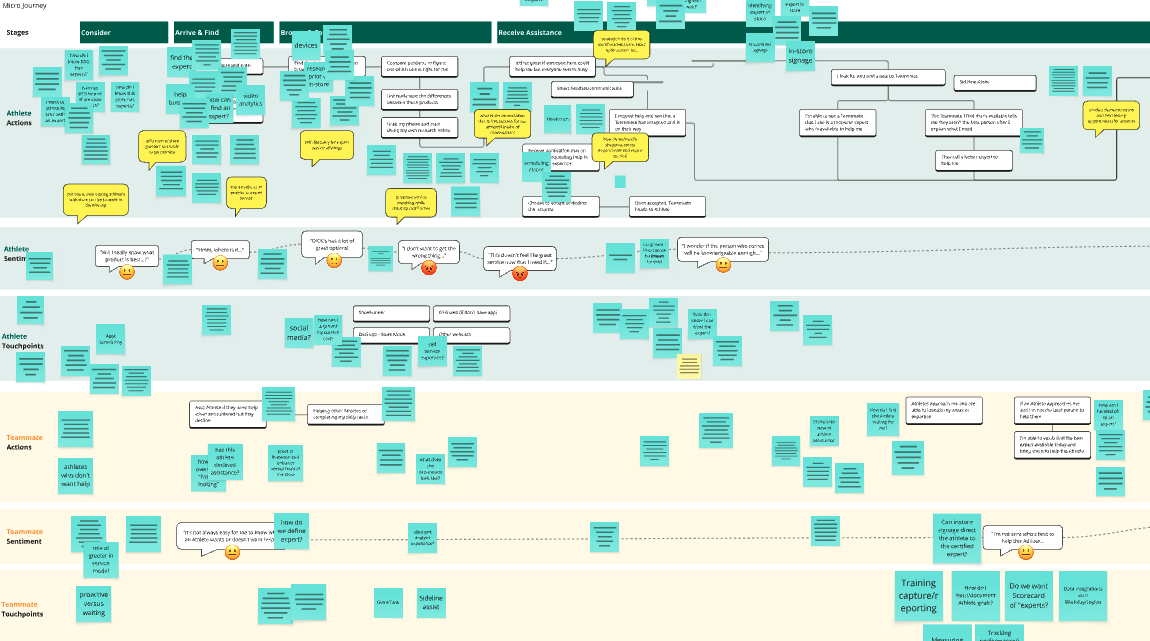
Employee certification journey map
End-to-end experience across identification, training, scheduling, and attribution — the alignment artifact that made scope negotiation possible.
From there, I took the output through a full service design lens. Not just "what's the training?" but the entire end-to-end experience — how employees get identified, how they're trained, how they're scheduled, how a customer knows who to engage with and how, how credit gets attributed. Working with business stakeholders and technology, we prioritized down to what we could actually test. I played an advisory role with our data team on measurement checkpoints and KPIs, and pushed our HR and training partners toward a train-the-trainer model with interactive components and role play — to actually develop the skills, not just check a box.
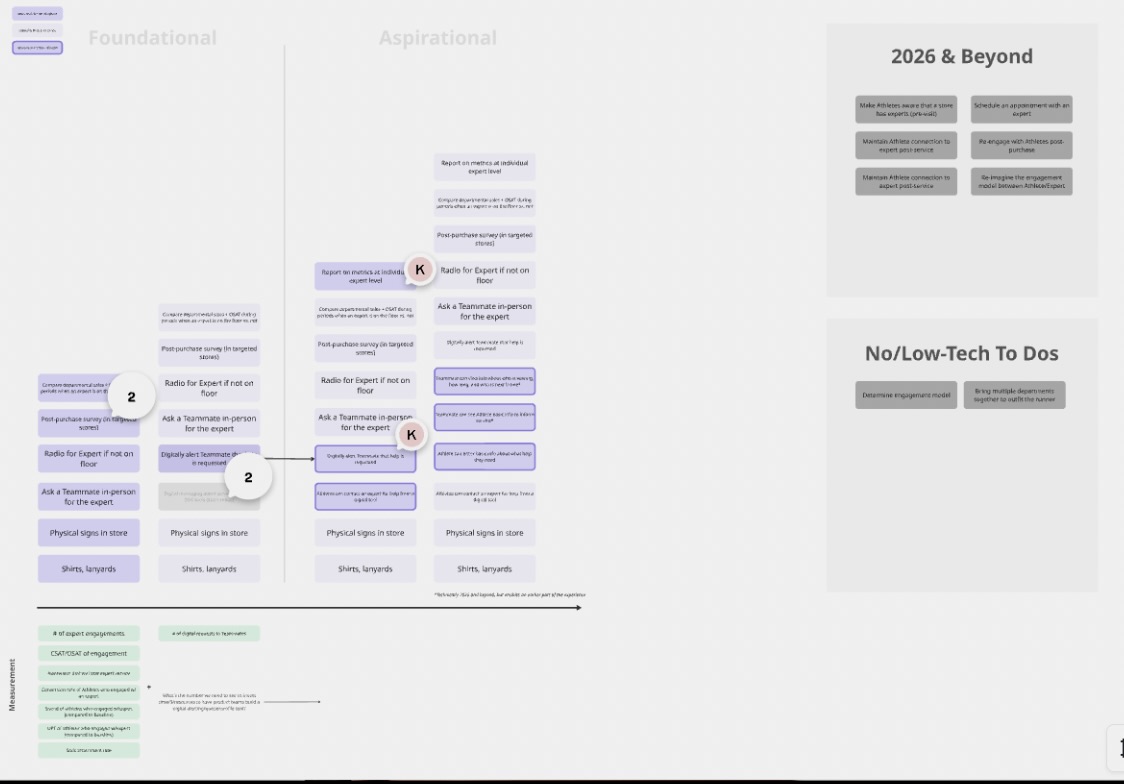
MVP prioritization
How we went from everything this program could be to what we could actually test in a pilot.
The program didn't unfold exactly as the initial hypothesis suggested. Where we thought the focus would land shifted once we got real signal from the pilot — which was exactly the point. We adjusted and kept moving, letting the learnings shape what came next.
The content direction ultimately landed on selling skills over sport-based expertise. It wasn't the direction I would have pushed for, but in an advisory capacity, my role was to raise the flag and let the business make the call. They did. And the program still worked.
I also conducted diary studies with customers — sending them into stores to experience the program firsthand and capture both behavioral patterns and initial reactions to the new service model. It added a layer of real-world signal to what could have stayed entirely internal.
The questions this program raised didn't close when the pilot ended — they got more interesting. How should a retailer think about service expertise at scale? Is certification the right model long-term? What's the right balance between human expertise, AI-assisted guidance, and something else we haven't figured out yet?
Those are questions I'm now directly positioned to help answer. My current role puts me in the Performance space — and while the work of figuring out the future of that looks different now than it did during this pilot, the thread is continuous. This program was the beginning of a longer inquiry, not a finished answer.
Not a perfect program. But a real one — with real signal, real employees, and a clear enough foundation to build on.